Retrieval Pipelines — from demo to production
Naive RAG — embed, top-5, stuff, pray — demos beautifully and plateaus at "mediocre with confidence." Production quality comes from treating retrieval as a pipeline with stages, each fixing a specific failure. Here's the assembly, stage by stage:
Stage 1 — Query transformation (fixing the question before searching):
- Rewriting for standalone-ness: in a conversation, "what about the pricing?" retrieves nothing — the topic lives three turns back (Topic 5's whiteboard, biting again). A cheap LLM call rewrites it into "what is the pricing of [the thing from turn 2]" before search. Non-negotiable for chat products.
- HyDE (Hypothetical Document Embeddings) — a genuinely clever move against Topic 51's Q-A asymmetry: have the LLM hallucinate a plausible answer first, and embed that to search with. The fake answer is wrong on facts but right on shape — it lives in answer-space, near the real answers. Hallucination, weaponized for good.
- Decomposition: "Compare our refund policy with our exchange policy" → two sub-queries, retrieved separately, merged.
Stage 2 — Retrieval, wide: hybrid search (Topic 51) plus metadata filters, fetching generously — top 50–150, not top 5. Because the next stage exists:
Stage 3 — Reranking. The conceptual heart of the pipeline. Embedding search is a bi-encoder: query and document were each compressed into a vector alone, never having met — fast (vectors precomputed) but lossy (Lesson 2's compression, forever). A cross-encoder reads the query and document together through a full transformer — every token of one attending to every token of the other (Topic 7, doing what it does best) — producing a far more accurate relevance score. Too slow to run against millions; perfect against a hundred. So: cheap wide net, then expensive precise sieve —
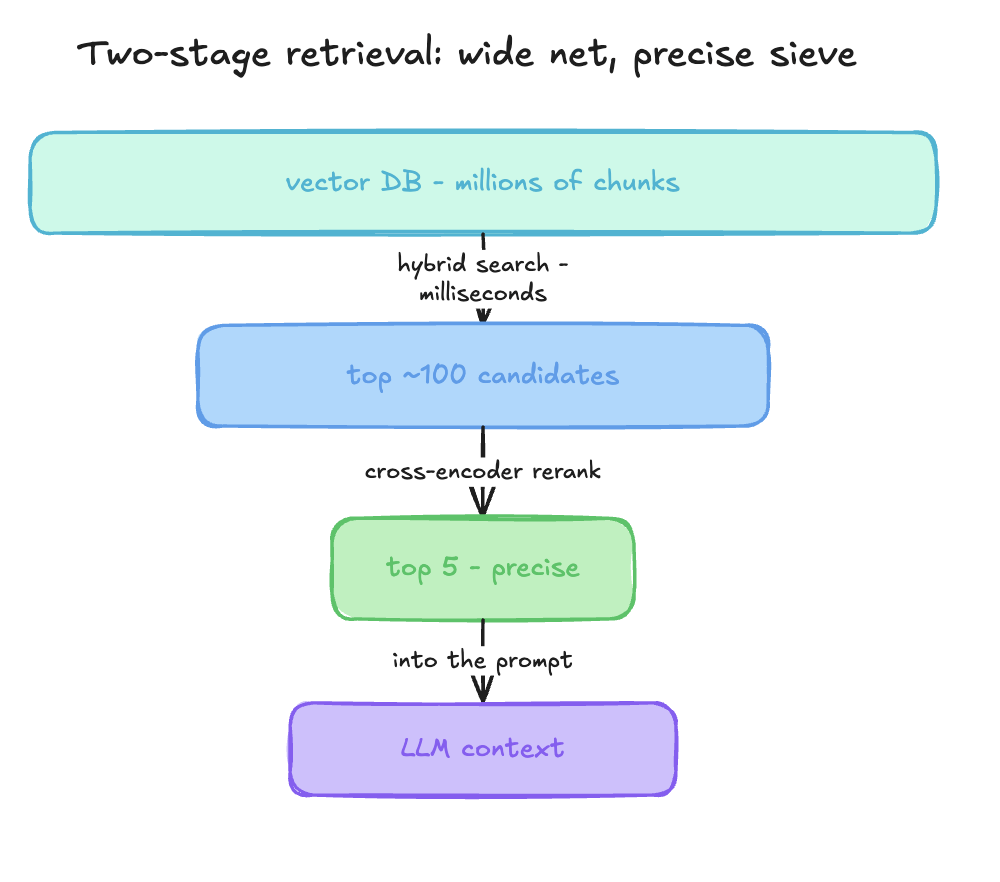
Recognize the shape? It's the course's recurring master pattern — cheap-wide then expensive-precise — the same economics as speculative decoding's draft-and-verify and routing's cascade. Rerankers are available as small local models (BGE-reranker and friends) or APIs (Cohere, Voyage); adding one is typically the single largest retrieval-quality jump available for an afternoon of work.
Stage 4 — Assembly. The survivors become a prompt, and details matter: order the chunks with the best at the start and end (Topic 5's lost-in-the-middle, now an engineering instruction), deduplicate near-identical chunks (your corpus has them; Topic 18 told you so), label each with its source for citations, respect the token budget (Topic 38's prompt dieting — more chunks ≠ better answers), and close with the grounding instructions from Topic 48.
And the stage that separates professionals: measurement. The single most important habit in RAG engineering is debugging retrieval and generation separately — because if the right chunk never made it into the context, no prompt engineering on Earth can fix the answer, and you'll waste days tuning the wrong stage. Build a golden set: 30–50 questions each mapped to the chunk(s) that answer them (you know how to build datasets — that's Module 2 muscle). Then track:
- Recall@k — is a correct chunk anywhere in the top k? (The retrieval health metric; if this is low, nothing downstream matters.)
- MRR — how high does the first correct chunk rank?
- And on the generation side, the RAG triad: was the retrieved context relevant? Was the answer grounded in it (every claim supported — an LLM-judge task with receipts, per Topic 21 layer 4)? Did it actually answer the question?
Every knob from this module — chunk size, hybrid weights, reranker on/off, k — becomes tunable the moment these numbers exist, and folklore the moment they don't.
One forward pointer: everything above is a fixed pipeline. The next evolution hands the retrieval decisions to the model itself — deciding whether to search, what to search for, reading results, and searching again if unsatisfied. That's agentic RAG, and it's three topics away (Module 7), built from tool calling.
Summary
Production retrieval = transform the query (rewrite/HyDE/decompose) → retrieve wide with hybrid + filters → rerank with a cross-encoder → assemble with ordering, dedup, citations, budget — and measure retrieval separately from generation with a golden set.
Mental model
A research assistant's workflow: clarify what's really being asked, gather widely, shortlist carefully by actually reading, arrange the briefing packet with the key pages on top — and keep a scorecard of how often the right document made it into the packet.
Mistakes to avoid
- Tuning the prompt when retrieval is the problem. Check recall@k first, always — it's the "is it plugged in?" of RAG debugging.
- Skipping query rewriting in a chat product, then filing "RAG doesn't work for follow-up questions" as a mystery. It's not a mystery; "what about pricing?" matches nothing by design.
Exercise
Build the golden set for your Topic 48 system — 15 questions mapped to their correct chunks — and measure recall@5. Then add one stage (hybrid from Topic 51, or a local reranker like BAAI/bge-reranker-base) and re-measure. One number, before and after: you've just done evidence-based RAG engineering, which puts you ahead of a startling fraction of production systems.