Hallucination Reduction — engineering for truth
The module's capstone, where planted threads pay off. First, the mechanical truth about what hallucination is, because misunderstanding it leads to bad engineering:
The model has no lookup that can fail. When you ask a database for a missing record, it returns null. When you ask a transformer about something it doesn't know, the machinery runs identically to when it does know: attention routes, FFNs fire, out comes a probability distribution, a plausible token gets sampled. There is no built-in "record not found" state. Fluency and confidence are properties of the text style, not signals of knowledge — the model learned confident prose from a trillion tokens of confident prose. Hallucination isn't a bug that malfunctions occasionally; it's the default behavior of a plausibility engine at the edge of its knowledge.
Why it happens — now with receipts from earlier topics:
- The objective rewards plausibility, not truth (Lesson 1). A fabricated citation in perfect academic format scores beautifully on "plausible next tokens."
- SFT on unknown facts trains confident guessing (Topic 14) — demonstrated in research: fine-tune a model to answer questions beyond its knowledge and hallucination measurably increases, because the learnable pattern was "always produce a specific answer," not the facts themselves.
- Preference tuning can make it worse (Topic 16): human and AI judges prefer confident, detailed, longer answers — so stage 3 can accidentally reward the confident-fabrication style over honest hedging.
- No grounding: asked about your private, recent, or niche facts with nothing in context, plausible invention is all the machinery can do.
A useful word here: calibration. A well-calibrated model's expressed confidence matches its actual accuracy — when it says "I'm fairly sure," it's right most of the time; when it doesn't know, it says so. Raw LLM training does not produce calibration. Engineering has to.
And because no single fix suffices, the professional approach is defense in depth:
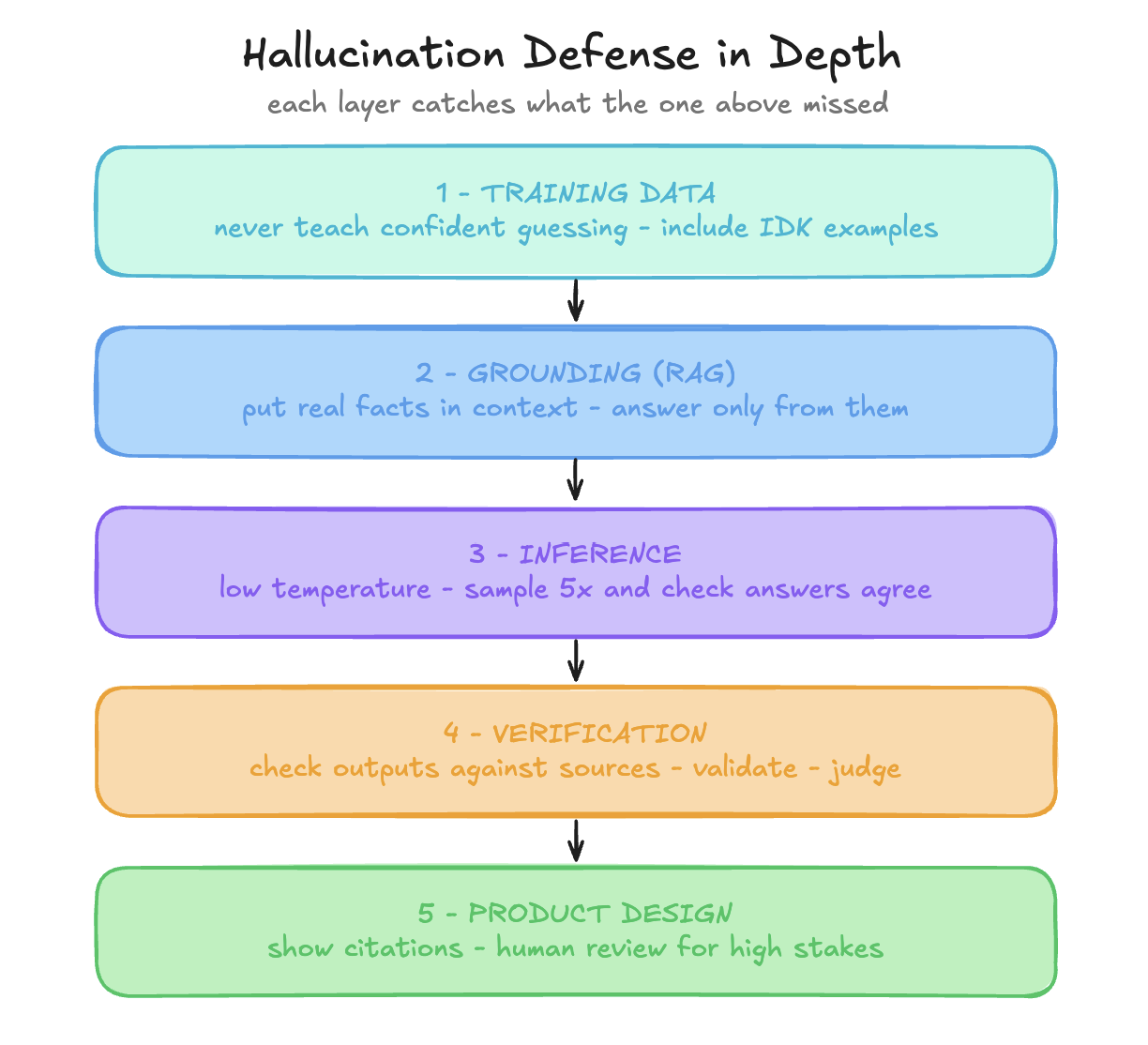
Walking the layers with the depth each deserves:
Layer 1 — Training data (this module's contribution). Three moves: (a) never SFT on facts the model can't know — you learned why in Topic 14; (b) include abstention examples — demonstrations where the ideal answer is "I don't know" or "I'd need to check X"; (c) the advanced version, abstention tuning (the R-Tuning idea): probe the model first — ask it a bank of questions, grade its answers, and split them into "knows" and "doesn't know." Then build SFT data where known questions get real answers and unknown ones get honest refusals. You're teaching the model the shape of its own knowledge boundary — which is exactly the calibration raw training never gave it. One warning: overdo the refusal examples and you create the opposite disease, a model that hedges on things it knows perfectly well. Abstention data needs the same mixture discipline as everything in Topic 18.
Layer 2 — Grounding. The single highest-impact layer in practice: don't ask the model to recall — hand it the facts in the context window and instruct it to answer only from what's provided, saying so when the context doesn't contain the answer. Recall from context is dramatically more reliable than recall from weights (the whiteboard beats the memory). This is RAG, getting its full treatment in Module 6; for now, register it as anti-hallucination measure #1 in nearly every serious product.
Layer 3 — Inference settings. Cheap wins: for factual tasks, drop the temperature (Lesson 1) — you want the model's top-probability belief, not adventurous sampling. And a genuinely elegant detection trick built on something you already understand: consistency checking. Ask the same question 5 times at moderate temperature. If the model knows, the answers agree — the probability mass is concentrated. If it's fabricating, the answers scatter (three different founding years, two different names) because it's sampling from a flat, uncertain distribution. Disagreement is a measurable uncertainty signal — the research version is called semantic entropy, but the intuition is just "a liar's stories don't stay straight." Costs 5× inference, worth it for high-stakes paths.
Layer 4 — Verification. Check outputs after generation: claims cross-checked against the retrieved sources ("is every statement in this answer actually supported by the provided context?" — an LLM-judge task with the receipts in hand, much easier than judging truth in a vacuum); structured outputs validated against schemas; code executed; citations resolved to confirm they exist. Anything verifiable should be verified — Topic 17's golden rule, resurfacing.
Layer 5 — Product design. The layer engineers forget because it isn't ML: show citations so users can check (and so fabrications become visible); route high-stakes outputs (medical, legal, financial) through human review; design UI language that sets accurate expectations. A product that displays its sources partially contains the hallucinations that slip through layers 1–4.
And the honest closing note, which distinguishes engineers from hype-merchants: hallucination is reduced, never eliminated. It's inherent to the plausibility-engine mechanism — every layer lowers the rate; none reaches zero. The professional question is never "how do I make it stop hallucinating?" but "what hallucination rate can this product tolerate, and which layers get me there?" A brainstorming tool tolerates a lot. A drug-dosage assistant tolerates almost none — hence layer 5's human in the loop.
Summary
Hallucination is the default output of a plausibility engine past its knowledge edge — fluent confidence included. Fight it in depth: honest training data and abstention tuning, grounding via RAG, temperature and consistency checks, post-hoc verification, and product design that shows receipts. Reduce, detect, contain — never "solved."
Mental model
A brilliant employee, incapable of silence, who answers every question in the same confident tone whether they know or not. You can train them to say "I don't know" (layer 1), hand them the file before asking (layer 2), ask five ways and watch for wobble (layer 3), fact-check their memos (layer 4), and never let their unreviewed word reach a client (layer 5). What you cannot do is make them someone else.
Mistakes to avoid
- Trusting confidence of tone. The model sounds identical at its most knowledgeable and its most fabricating — by construction. Only external checks distinguish them.
- Betting everything on one layer ("we have RAG, we're safe"). Models can hallucinate around provided context — contradicting it, or blending it with invention. RAG shrinks the problem; verification catches the remainder.
Exercise
Hallucination-hunt any model you like. Ask 5 questions you can verify: two you're sure it knows (famous facts), two at the edge (obscure-but-real people, minor 2019 events), one about something that doesn't exist ("the 2018 Lahore Protocol on AI safety"). For the nonexistent one, ask 3 times in fresh chats and compare — watch the fabrications disagree with each other. You've just run layer-3 consistency detection by hand, and you'll never again mistake fluency for knowledge.
Module 2: complete. The full data discipline is yours: demonstration, preference, and synthetic data; formatting that doesn't silently kill runs; curation with mixtures, dedup, and decontamination; cleaning as a loop; continued pretraining as the true knowledge path; and truth as an engineered, layered property.
Next: Module 3 — Fine-Tuning Methods. LoRA and QLoRA (where Lesson 2's 8× training-memory flag finally cashes out — you'll see how to fine-tune a 7B model on hardware like your own Mac), DPO and RLHF (the algorithms that consume your Topic 16 preference pairs), quantization, checkpoints, adapters, and GGUF. This is the module where you stop preparing data and start running training.