Landing the YC / a16z / Silicon Valley Job — the mechanics
Now the target itself. First, understand how these companies actually hire, because it's structurally different from big tech: teams of 5–50, hiring decided by founders/senior engineers in days not months, work-sample culture (they'd rather watch you build than watch you LeetCode — though some still do DSA rounds, so don't be helpless there), and referrals + inbound proof-of-work massively outperform cold applications. The role names you're hunting: AI engineer, LLM engineer, founding engineer, member of technical staff, forward-deployed engineer (FDE — engineer embedded with customers building on the product; currently one of the hottest and most accessible AI-startup roles, and a natural fit for anyone with community/DevRel DNA), and DevRel engineer.
Where the jobs physically are: YC's Work at a Startup (workatastartup.com — applications land in founders' inboxes, not ATS purgatory), the a16z portfolio job board and each portfolio company's careers page, Wellfound, the monthly HN "Who is hiring?" thread, and — underrated channel — founders announcing hires on X, where a reply with an artifact beats a hundred queued résumés.
The playbook that actually converts — proof-of-work outreach, and it's the entire module compressed into a motion:
For each target startup (pick 10, not 100): (1) genuinely use their product; (2) build something — an integration, a demo on their API, an eval of their model, a reproduced-and-diagnosed bug, a PR; (3) send the founder/CTO a 5-sentence note: what you built, what you found (including problems — respectfully specific beats flattering), link to the artifact, one line of who you are (your Topic 85 positioning), ask for a conversation.
This converts at rates that make spray-applying look broken, because you've pre-performed the work sample and demonstrated the exact behavior startups hire for: initiative on their actual product. It's also simply the same motion as Topic 87's OSS ladder and Topic 89's substantive replies — proof-of-work, aimed.
The interview loop, mapped to your curriculum: expect (a) a practical build — take-home or pairing: "build a RAG service over these docs," "get this fine-tune working," "add a tool to this agent" — Modules 3/6/7 live; (b) LLM system design — "design a support bot for 1M users: models, serving, costs, failure modes" — literally your Topics 38/70/77 capstone documents recited; (c) the project deep-dive — they will drill into your flagship to verify you built it and probe what you measured ("how did you know it improved?" — Module 10 is the separator here; candidates who answer with eval methodology are rare and get offers); (d) increasingly, eval-thinking questions outright; and (e) product sense (Topic 84 — "should this feature use AI at all?"). Notice: this course is the interview prep; the gap is only reps.
The international path — the honest sequence (for building from Pakistan toward SF): (1) Remote-first roles and contract work at these same startups exist and are won by exactly the playbook above — expect global competition and signal flexibility on timezone overlap explicitly. (2) Prove yourself remotely → relocation + sponsorship becomes a conversation with an employer who already wants you, which is the only version of the visa conversation that goes well. (3) Know the O-1 visa exists — the "extraordinary ability" route — and internalize the beautiful alignment: its evidence criteria (original contributions, press/writing, judging others' work, critical roles in distinguished organizations) are literally this module's outputs. Your OSS maintainership, published benchmarks, community leadership, and launched products are a visa case assembling itself; build with that dossier consciously in mind. (4) The founder path runs in parallel — YC accepts applications from anywhere and relocates accepted companies. And the overriding principle: don't wait for geography. The network, the repos, the launches, and half the jobs are on the internet; the flywheel spins from anywhere:
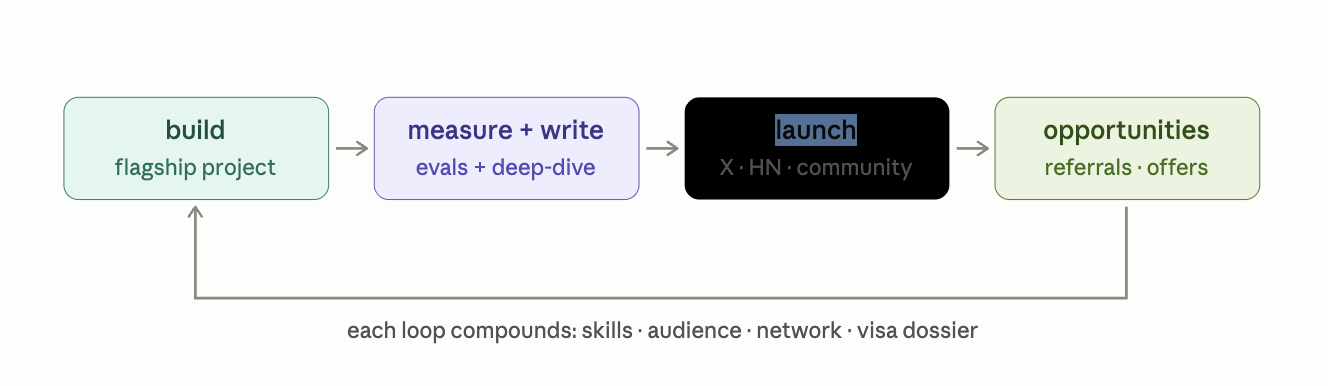
One pragmatic footnote before the ritual: when offers come, understand startup equity before signing — ask for the numbers that make options mean something (total shares outstanding, strike price, latest valuation, vesting cliff), because "0.3%" is not information without them. Founders respect the question; it signals you've been around the block you're trying to enter.
Summary
Startups hire on work samples and referrals, through founder-reachable channels (Work at a Startup, portfolio boards, HN, X). The converting motion is proof-of-work outreach: build on their product, send the artifact. Interviews = your capstone documents performed live, with eval-thinking as the separator. International path: remote-proven first, O-1 dossier assembling itself from this module's outputs, geography never blocking the flywheel.
Mental model
You're not applying for jobs; you're pre-doing them in public, ten square meters at a time, until someone says "just come do this here, with equity."
Mistakes to avoid
- Spraying 200 résumés into ATS systems and calling it a job search. At startups that channel is where applications go to rest; ten proof-of-work notes beat it by an order of magnitude.
- Waiting to be "ready" before outreach. The artifact you'd build for step (2) of the playbook makes you ready — readiness is an output of the motion, not a prerequisite.
Exercise · the module's capstone
Build your target list of 10 startups (mine Work at a Startup, the a16z portfolio, and your own X timeline — companies whose products you genuinely rate, in your spike area). For the top 3, complete the full playbook this month: use the product for real, build one small artifact each (an eval of their API, an integration, a diagnosed bug), and send the 5-sentence note. Track responses. Whatever happens, you'll have three new portfolio pieces and your first data on the highest-converting motion in startup hiring.
The 12-Month Arc — everything in this module, sequenced
Q1 — Foundation: choose your positioning (85) and flagship (86); begin the target-repo apprenticeship (87); publish two deep-dives from course work you've already done (89). Q2 — The flagship ships: all four artifacts (repo, numbers, writeup, demo); launch properly (HN + communities); land the first substantive OSS contribution. Q3 — Product + aim: the two-week concierge product, monetized (88); two more deep-dives; build the 10-startup list and run the outreach playbook on the first three (90). Q4 — Compound: second Tier-A project or double down on whatever got signal; a talk; outreach round two — now with a portfolio that speaks before you do, and an O-1-shaped paper trail accumulating quietly underneath.
Twelve months of this loop, run honestly, puts you in roughly the top percentile of candidates these companies see — not because the work is superhuman, but because the loop's power is consistency and almost nobody sustains it past month two. The models in this course were trained by gradient descent: small correct updates, relentlessly repeated, compounding into capability nobody could have hand-coded. Your career runs on the same optimizer. Same math. Start the loop.
That closes Module 12 — and now truly the full curriculum, engineering and career both. If you want, we can go one level deeper on any piece of this: drafting your actual positioning sentence, spec'ing your flagship in detail, or writing the first proof-of-work outreach note together.