Proof-of-Work — what "personal brand" actually means for engineers
Delete the influencer image. For engineers, personal brand = discoverable evidence of ability. When a YC founder or an a16z-portfolio CTO considers you, they do one thing before any interview: they look you up. Your brand is literally what they find in those ninety seconds — and the hierarchy of what counts is brutal and consistent:
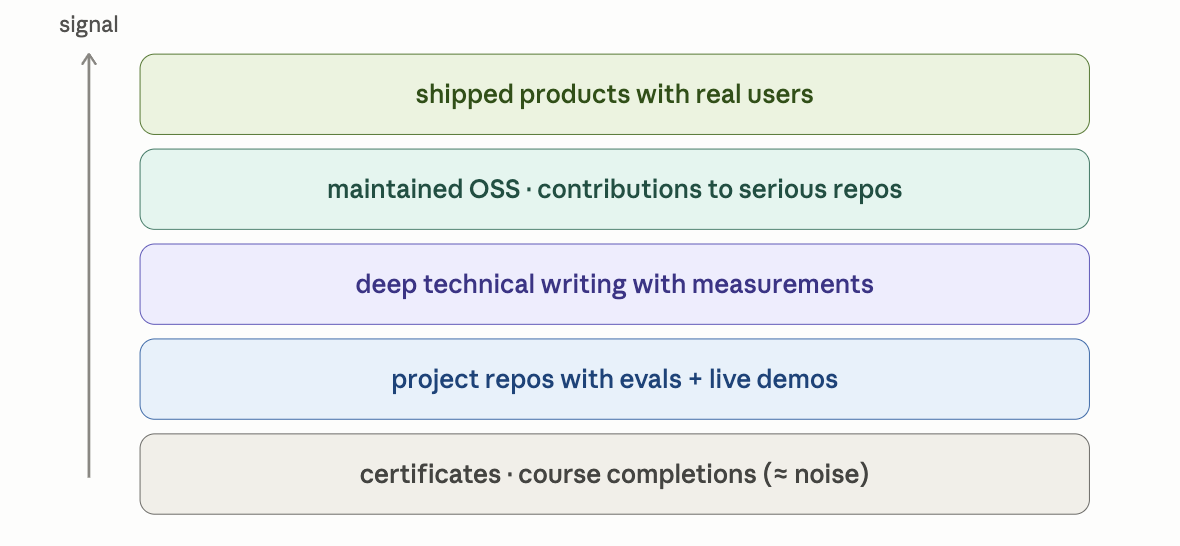
Read the bottom row honestly: certificates and course completions — including this course — are approximately noise in startup hiring. Nobody at a 12-person company cares what you studied; they care what you made, whether it worked, and whether you can prove it. That's not cynicism, it's the good news: the currency is artifacts, and artifacts can be manufactured by anyone with a laptop and discipline, from anywhere on Earth — including Lahore. Geography gates offices; it does not gate proof-of-work.
Two design decisions turn scattered work into a brand:
1. Positioning — become legibly "the person who X." Generic ("AI engineer passionate about LLMs") is invisible; specific is memorable. Strong positionings sound like: "fine-tunes small models that beat frontier models on narrow tasks, and publishes the evals" — or "builds and benchmarks local-AI inference" — or "makes rigorous evals for underserved languages." Note the shape: a T — broad across this course's twelve modules (you can converse anywhere), spiked deep in one or two (you're known for something). Pick the spike deliberately; Topic 86 gives you the menu.
2. Public by default. Every project ships with a README that sells (what it does, the numbers, a GIF, how to run it), a writeup, and where possible a live demo (HF Spaces makes this free). The private repo where your best work sleeps is a brand asset earning 0%. And note what the hierarchy's top four rows share: they all contain measurements. The Module 10 discipline — publish the evals, the benchmarks, the cost math — is precisely what separates engineer-brand from AI-influencer slop, because almost nobody posting about AI brings numbers. Your differentiation is rigor made public.
Summary
Brand = the evidence found in a 90-second lookup. Rank: products > maintained OSS > measured writing > project repos > certificates. Choose a legible spike, make everything public, and let Module 10's numbers be your signature.
Mental model
A courtroom, not a stage. You're not performing for an audience; you're assembling exhibits for a future skeptical juror (the founder googling you). Every artifact either enters evidence or doesn't exist.
Mistakes to avoid
- Collecting certificates while your repos sit empty. That's optimizing the noise row. One shipped, measured project outweighs every certificate you could ever earn — reallocate ruthlessly.
- Positioning as "generalist AI enthusiast." The market has infinite enthusiasts; it has a shortage of the person who X. Vague breadth reads as no depth.
Exercise
Do the 90-second audit on yourself, honestly: open an incognito window, search your name + "github," and grade what a founder finds against the pyramid. Then write your one-sentence positioning ("the person who ___") — the sentence every artifact from here forward will reinforce.