AI Agents — the loop, demystified
Everything converges here, and the demystification is total:
An agent is a while-loop around tool calling. Model thinks, picks an action, your code executes it, the result joins the context, repeat — until the model decides the goal is met or a guard says stop.
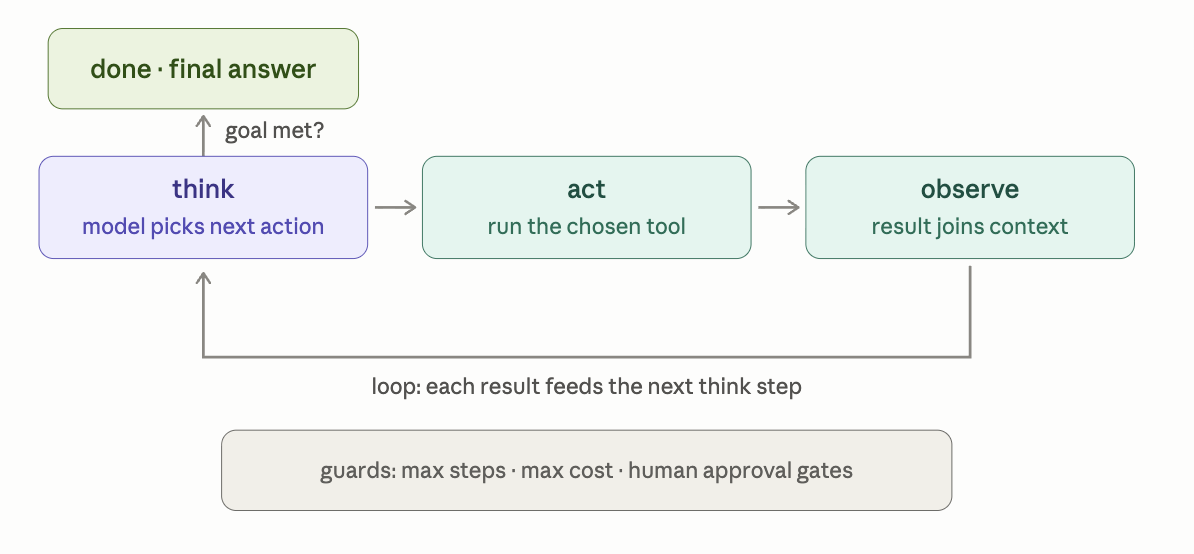
And in code — the twenty lines I promised, which are also, structurally, the core of Claude Code, Deep Research, and every agent product you've used:
def agent(goal, tools, max_steps=15, budget_tokens=200_000):
    history = [{"role": "user", "content": goal}]
    for step in range(max_steps):                          # guard 1
        resp = client.messages.create(model=..., tools=tools,
                                      messages=history, system=SYSTEM)
        history.append(assistant_turn(resp))
        if resp.stop_reason != "tool_use":                 # model says: done
            return resp.text                               # final answer
        for call in tool_calls(resp):                      # act (maybe parallel)
            if call.name in CONSEQUENTIAL:                 # guard 2
                confirm_with_human(call)
            result = execute(call)                         # your hands
            history.append(tool_result_turn(call.id, result))   # observe
        if tokens_used(history) > budget_tokens:           # guard 3
            history = compact(history)                     # see below
    return "stopped: step budget exhausted"                # guard 1 fires
That's the whole species. The lineage name you'll see cited is ReAct ("reason + act") — the 2022 formalization of interleaving thinking and tool use — but the loop predates and outlives any acronym. What makes the difference between a demo and a product is not the loop; it's four disciplines, each of which this course has already armed you for:
1. The compounding constraint is the design center. Topic 38's math returns as the module's gravitational force: 0.95¹⁰ ≈ 60%. Ten steps of 95%-reliable behavior yields a coin flip. Agents don't fail exotically — they fail by ordinary error accumulation. Every mitigation follows from taking the exponent seriously: raise the base (better tools, teaching error messages from Topic 57 so steps self-correct, tighter tool scopes), lower the exponent (smaller task scopes, decomposition — next lesson's workflows), insert verification steps (have the agent check its work — run the tests, re-read the output against the goal), and add recovery points (human gates at consequential moments; checkpoints so a step-9 failure doesn't vaporize steps 1–8).
2. Context engineering — Module 6, cashed per-step. Topic 53's closing truth ("all memory is prompt assembly") is now a per-iteration job: each loop turn, the model sees system prompt + goal + accumulated history — and long trajectories bloat, cost (Topic 5: whole whiteboard, every step), and degrade attention. Production agents compact: summarize old steps into a running digest (rolling summarization), keep recent turns verbatim (working memory), stash large artifacts outside context and retrieve on demand (episodic — often literally "write findings to a file, read back what's needed," the MemGPT paging pattern with a filesystem as disk). An agent's quality over long tasks is mostly the quality of its context curation.
3. Verification asymmetry decides where agents work. Agents shine where results are checkable: code runs or doesn't, tests pass or don't, the JSON validates or doesn't. Cheap verification converts "95% per step" into "95% per attempt, retried until verified" — a categorically better reliability regime. This is why coding agents got good first (the compiler is a free verifier), why Topic 27's RLVR trains reasoning on math and code, and why, when you design agent tasks, the highest-leverage question is: what can be verified here, and how do I make the agent verify it? Open-ended tasks with no check ("write a great strategy") stay hard for exactly this reason.
4. Reach for an agent last, not first. The loop's power is that the model chooses the control flow — which is also its cost: nondeterminism, compounding, unpredictable latency and spend. The field's hard-won guidance (Anthropic's "Building Effective Agents" essay is the canonical statement): use the simplest structure that works. A single prompt, then a fixed chain of prompts, then a workflow where your code decides the steps — and the full autonomous loop only when the task genuinely can't be pre-decomposed because the path depends on what's discovered along the way. That workflow-vs-agent spectrum is precisely where the next lesson begins.
Summary
Agent = while-loop of think → act → observe with guards. Products differ from demos via: fighting the compounding exponent, per-step context curation, building around verifiable outcomes, and choosing the least autonomy that solves the task.
Mental model
A capable junior colleague on a long assignment: works in cycles, keeps notes because their desk (context) is small, checks their own work when checking is possible, asks before doing anything irreversible — and whose ten-step projects succeed only if each step is very reliable, because errors compound silently.
Mistakes to avoid
- Shipping the loop without guards. An unguarded agent that gets confused will happily burn 400 steps and your API budget re-reading the same file. Max-steps, max-cost, and gates are not polish — they're the difference between a tool and an incident.
- Blaming "the model isn't smart enough" when an agent fails at step 8. Autopsy the trajectory first: nine times out of ten the failure is a vague tool description, a bloated context, an uninformative error return, or a missing verification — all fixable without touching the model.
Exercise · the lesson's capstone
Upgrade your Topic 56 build into a real agent: give it three tools — search_docs over your Module 6 pgvector index (agentic RAG, live), a calculator, and read_file — wrap the twenty-line loop with max_steps=10, and set it a goal requiring 3+ steps ("find what our docs say about X, compute Y from it, and summarize both"). Then run it five times and read all five trajectories. Count: how many steps did each take? Did any loop redundantly? Did errors self-correct? You've just done agent-trajectory analysis — the actual daily work of agent engineering, and the skill Lesson 12 builds on.
Lesson 11 complete. The control surface is fully in your hands: prompts as distribution-shaping, system prompts as tested constitutions, function calling as a four-beat text protocol, tool craft with its security teeth, and the agent revealed as a guarded while-loop whose real challenges — compounding, context, verification — are ones you've been training for since Topic 5.
Lesson 12 finishes Module 7: agentic workflows (the pattern library between "one prompt" and "full agent" — chaining, routing, parallelization, orchestrator-workers, evaluator-optimizer), multi-agent systems (when many loops beat one, and the coordination tax nobody mentions), and browser agents (the hardest tool environment there is — where every lesson from this module gets stress-tested at once).