Transformers — the full architecture
Now assemble the machine. The transformer (from the 2017 paper "Attention Is All You Need") is what happens when you stack attention with a few other components, many times.
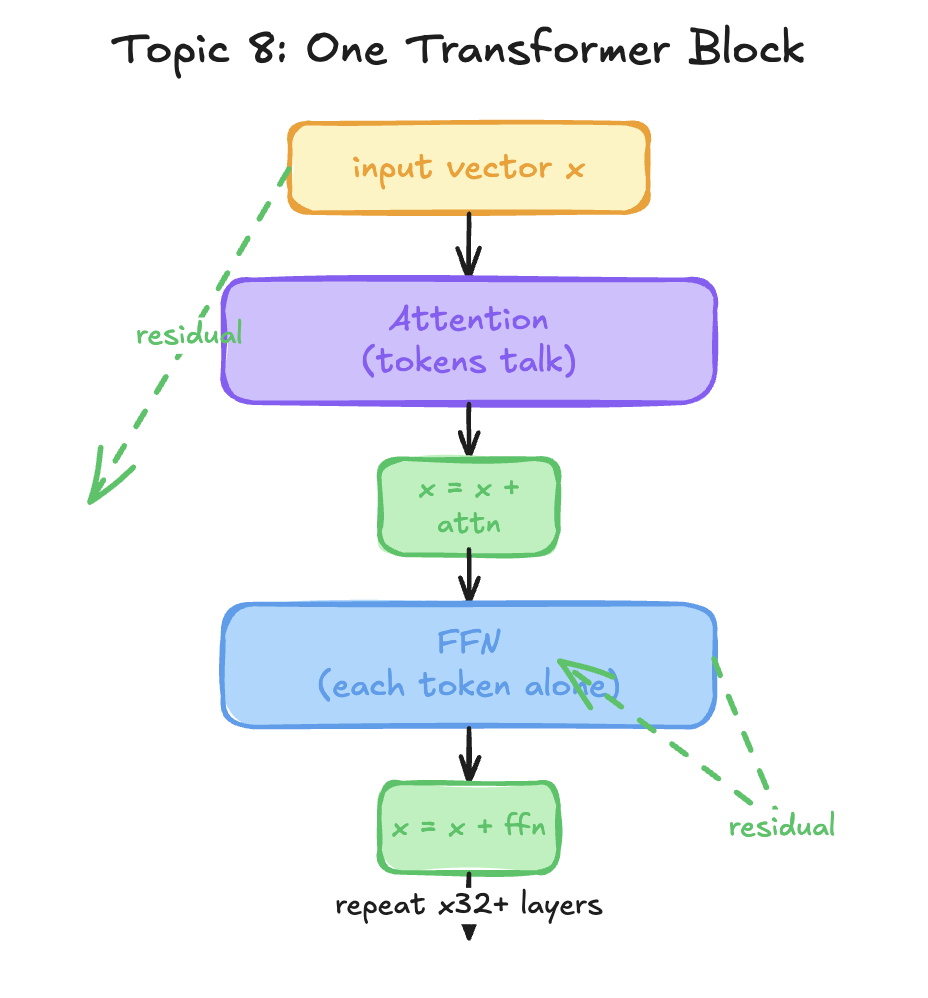
One transformer block = two stations:
Station 1 — Attention (Topic 7): tokens exchange information. This is the communication step. "Let every word gather context from other words."
Station 2 — Feed-Forward Network (FFN, also called MLP): each token, now enriched with context, gets processed individually by a small neural network. No token-to-token communication here. This is the thinking/lookup step — research suggests FFNs act like the model's key-value memory where facts and patterns are stored. Roughly: attention figured out "we're talking about the capital of Pakistan," and the FFN is where "→ Islamabad" gets retrieved.
Daily-life analogy: A team workflow with alternating phases. Phase 1: everyone in a meeting room, sharing information (attention). Phase 2: everyone goes back to their desk and processes what they heard alone (FFN). Then another meeting, another desk session — repeated 32–100+ times.
Around these two stations there's plumbing that makes deep stacks trainable:
- Residual connections: each station's output is added to its input, not replacing it:
x = x + attention(x). The token's vector is like a running document, and each layer appends edits rather than rewriting from scratch. Without this, gradients die in deep networks and training fails. Arguably the most underrated trick in deep learning. - Normalization (LayerNorm/RMSNorm): rescales vectors between stations so numbers don't explode or vanish. Think volume control between amplifier stages.
- Positional information: attention itself is order-blind — "dog bites man" and "man bites dog" would look identical. So position gets injected into the vectors. Modern models mostly use RoPE (rotary embeddings), which encodes position as a rotation of the Q/K vectors — a clever scheme, and the thing people manipulate ("RoPE scaling") to stretch context windows beyond training length.
The full pipeline, end to end:
text → tokenizer → token IDs → embeddings
     → [Block 1: attention + FFN]
     → [Block 2: attention + FFN]
     → ... (×32 for a 7B model, ×80+ for the biggest)
     → final vector for the last position
     → unembedding matrix → scores over the whole vocabulary
     → softmax → probabilities → sample one token
     → append it to the input, REPEAT THE WHOLE THING for the next token
That last line deserves emphasis: generation is autoregressive — one token at a time, each full forward pass producing exactly one token, which gets appended and fed back. A 500-token answer = 500 full passes through the entire stack. (Now you can already smell why the KV cache in Module 4 exists — recomputing attention for all previous tokens every pass would be insane.)
What happens across depth? Interpretability research shows a rough progression: early layers handle syntax and local structure, middle layers build semantic and factual representations, late layers get concrete about the specific next token. The vector flowing through is a thought being progressively refined.
One more term you'll encounter: the original 2017 transformer had an encoder (reads input bidirectionally) and decoder (generates output). Modern LLMs — GPT, Llama, Qwen, Claude — are decoder-only: just the generation stack with causal masking. Embedding models like BERT are encoder-only. When you see these words, that's all they mean: which half of the original design survived.
Summary
A transformer stacks blocks of [attention → FFN] with residual connections and normalization, ending in a vocabulary-wide prediction. Generation runs the whole stack once per output token.
Mental model
An assembly line for meaning: alternating meeting rooms (share context) and desks (process alone), 32+ floors tall, producing one token per full trip.
Mistakes to avoid
- Thinking the model generates whole sentences in one shot. It's one token per full forward pass — this is the reason inference speed is measured in tokens/second.
- Believing attention is where knowledge lives. Roughly ⅔ of a model's parameters are in the FFNs — that's the warehouse; attention is the routing.
Exercise
Sketch the pipeline above on paper from memory, then trace this input through it: "Pakistan's capital is". Write down what each stage roughly does, and what the probability distribution at the end might look like (which tokens high, which low). If you can teach this diagram to a friend, you understand transformers better than most people using them professionally.