DPO — the shortcut that took over
In 2023, a paper arrived with a title that summarizes itself: "Direct Preference Optimization: Your Language Model is Secretly a Reward Model." Its result reshaped open-source practice within months.
The insight, plain-language version: the RLHF setup — reward model + KL-leashed policy optimization — has enough mathematical structure that you can solve it on paper. The optimal policy and the reward model turn out to be two views of the same object, connected by a formula. So instead of building the judge and then chasing its scores through an unstable RL loop, you can skip both and write down a direct loss on the preference pairs themselves:
For each (prompt, chosen, rejected) triplet: nudge the model to make the chosen answer more probable than the reference model finds it, and the rejected answer less probable than the reference finds it.
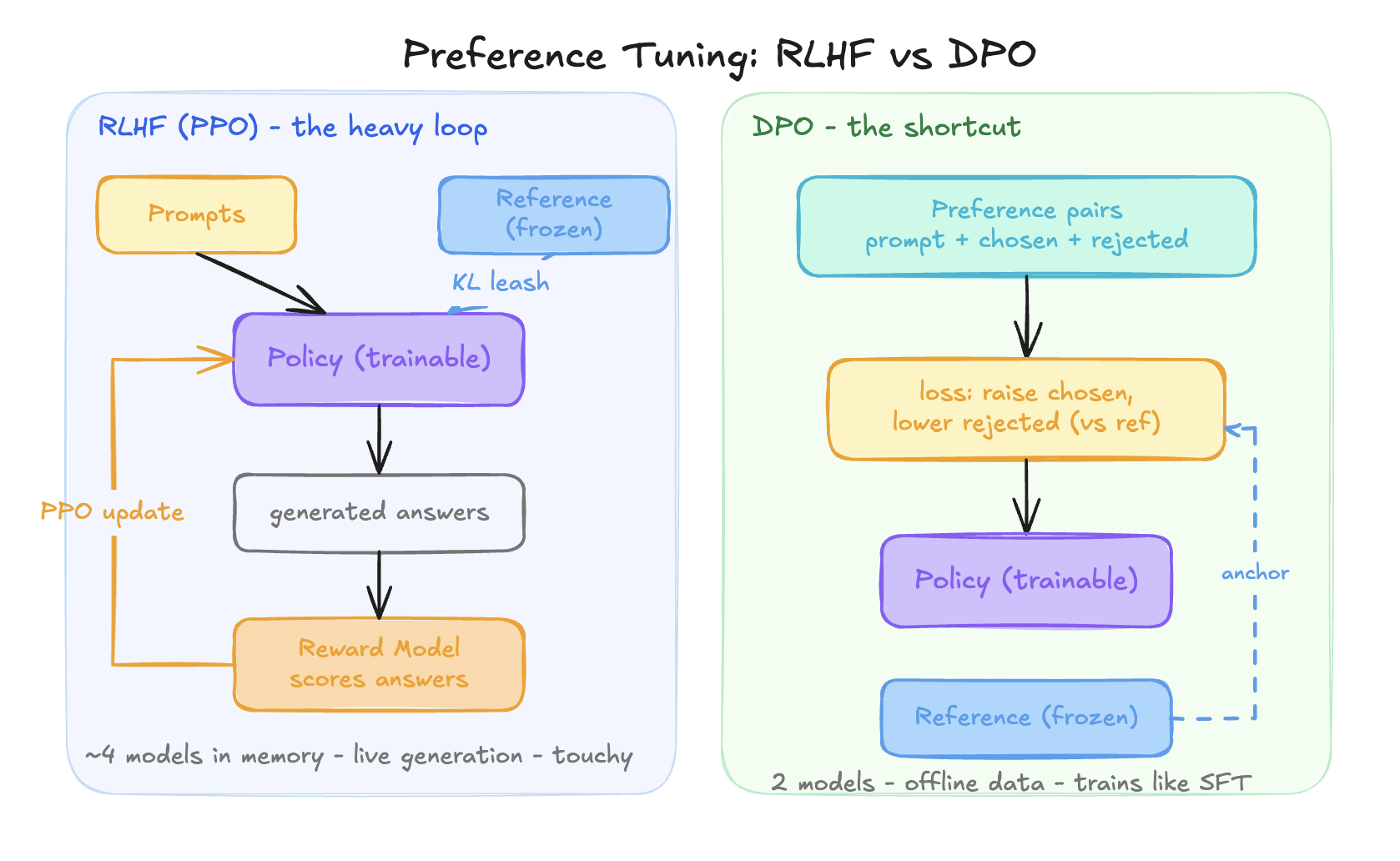
That's the whole algorithm. Notice what survived the collapse: the reference model still anchors everything (comparing against it is what plays the KL-leash role — the "stay yourself" rule is baked into the loss), and a knob called beta sets leash tightness (typical 0.05–0.3; higher = more conservative). What vanished: the reward model, the value model, the generation-inside-training loop, the RL instability. Here's the whole comparison in one picture:
The practical consequences of that right-hand panel are why DPO conquered open source: it trains like plain supervised learning — fixed dataset, standard loop, stable loss curves, two models in memory instead of four. And even the "two models" softens with a LoRA trick worth knowing: since your policy = base + adapter, the reference is just the same base with the adapter switched off — one copy of weights serves both roles. QLoRA + DPO on a single consumer GPU is routine. In TRL, it's deliberately anticlimactic:
from trl import DPOConfig, DPOTrainer

trainer = DPOTrainer(
    model=model,                      # your SFT'd model (adapter attached)
    args=DPOConfig(output_dir="dpo_out", beta=0.1, learning_rate=5e-6),
    train_dataset=pairs,              # columns: prompt, chosen, rejected
    processing_class=tok,
)
trainer.train()
Note the learning rate: ~5e-6, drastically gentler than SFT's 2e-4 — preference tuning is a finishing pass over an already-good model, and heavy hands break things fast here.
The honest comparison — because "DPO won" needs an asterisk. PPO-style RLHF is on-policy: the model learns from its own fresh outputs, exploring and getting corrected where it actually lives. DPO is offline: it studies a fixed binder of comparisons, which may describe answers unlike anything the current model would say. On-policy learning is genuinely more powerful when done well — it's why frontier labs still run RL variants, and why RLVR (verifiable rewards) dominates reasoning training. DPO's sweet spot — which happens to be your sweet spot — is: you have preference pairs, modest compute, and want stage-3 polish without an RL team. And recall Topic 16's advanced note, now fully explainable: generating your pairs from your own model's outputs (sample 4, rank, take best/worst) makes DPO quasi-on-policy — the binder describes the model's actual neighborhood. That one data decision closes much of the gap.
The variant zoo, decoded in one line each so no acronym ever intimidates you: IPO (patches a DPO overfitting quirk), ORPO (fuses SFT + preference into a single stage — no reference model at all), SimPO (drops the reference too, via length-normalized scoring), and the one with real product relevance for you: KTO, which trains on unpaired thumbs-up/thumbs-down labels instead of pairs. Sit with that: every product with a 👍/👎 button is passively collecting KTO-ready training data. If you ever ship an AI SaaS, that feedback widget is a preference-dataset factory.
The standard modern recipe, and what you'd actually run: SFT first, then DPO — teach the format with demonstrations, then polish the judgment with comparisons. Stage 2, stage 3, exactly as the Lesson 3 pipeline diagram promised.
Summary
DPO collapses reward-model + RL into one direct classification-style loss on preference triplets, anchored to a reference model with tightness knob beta. Stable, cheap, two (effectively one) models — the open-source stage-3 default, with on-policy RL remaining the frontier's tool.
Mental model
RLHF hires a food critic and runs months of live kitchen trials. DPO hands the chef the binder of "diners preferred dish A over dish B" and has them study the pattern directly. Same lessons learned — no critic salary, no kitchen chaos. (And the binder teaches best when it reviews this chef's own dishes.)
Mistakes to avoid
- Running DPO on a base model that never had SFT. DPO adjusts relative preferences between answers; it assumes the model already produces reasonable answers to prefer between. Format first, polish second.
- Reusing SFT's learning rate for DPO and destroying a good model in 50 steps. Drop it ~40×; when in doubt, gentler.
Exercise
Extend your Topic 16 exercise into a real DPO dataset: take your 5 chosen/rejected pairs and reformat them as JSONL with prompt, chosen, rejected fields. Then answer two design questions in writing: (1) which of your pairs would length bias corrupt if you scaled this to 5,000 examples, and how would you counter it? (2) How would you regenerate these pairs on-policy once you have a fine-tuned model? Twenty minutes, and you've designed a stage-3 pipeline.